On being a self-taught developer
Articulating the stigma that comes with that dreaded term

When I was a senior frontend developer at my previous employer my position existed in a structural limbo. Financially I was a shared expense, without explicitly being a part of the shared services group, and initially I reported to the COO, but his tenure there was so short that I ended up in marketing, the team I did the majority of my work with, which was a nice fit.
Still, there was tension. Since I relied on IT for support on a variety of my tasks there was grumbling about the fact that marketing was draining IT services for non-crucial items, and as IT’s red-headed step-child all of my projects were last in line for support. Conversations happened around me, but not with me until finally I met with Director of Engineering to discuss what I did and how I might fit into the IT org.
It was a friendly conversation where we reviewed my skills and background, and then he said something I’d never heard in any of the professional conversations I’ve had since I started Pixelsmith Design in 2008: “You’re a self-taught developer, no?” And it wasn’t just what he said, but the way he said it that made it clear that this made me less valuable to him. I don’t remember what I said or how I replied, I just remember feeling like I’d gotten in trouble for something I hadn’t realized I’d done. It was a terrible feeling.
This wasn’t the first time I’d run into this prejudice, but it was the first time that someone had said it out loud. Part of it is ageism: a ton of frontend devs are self-taught because there were no frontend programs or classes when we started coding in the ‘90s. I just had to learn it from friends and books. Looking back now I see the ways that I’d cherished the mythology that built around starting as a developer in my friend’s garage, learning HTML and Photoshop in order to build a website to post my poetry online. The is the Ur myth of technology, the scrappy, self-taught outsider making good on those early childhood experiments.
And now, here, this gate-keeping stranger uttered the phrase, “self-taught developer” and its condescension sheared all of the mythology that I’d built up around my identity in my 16 year career as a frontend dev, leaving only the imposter syndrome behind.
I didn’t move to IT, which I ended up being grateful for. Another fantastic contributor did move from our utilities group to the IT group, and within 6 months he was gone. His new supervisor, the same man who’d called me self-taught, gave him a terrible performance review and sent him packing after 7 years of top performance in his previous business unit. Scuttlebutt was that the supervisor had him teach all of his duties to a contractor and then got rid of him. Maybe he was self-taught too.
The phrase still haunts me. Don’t get me wrong, being a self-taught freelancer has disadvantages, imposter syndrome being the biggest among them. Then there are times I still struggle with names for common programming patterns or array structures because I’ve learned them experientially, not academically. When someone talks about object oriented programming (OOP) I get really anxious, but then when I read the code, I know what’s going on.
The thing that frustrates me the most about the illusion of the self-taught developer every single developer is self-taught, even if they aren’t only self-taught. Nobody comes out of school knowing how to do the job that they end up getting. They have to learn that on the job. And technology doesn’t stand still, but moves rapidly, requiring developers to continually self-teach to stay relevant. The implication that I’m less valuable as a developer because I don’t have a computer science degree is ludicrous, and reflects the way in which our implicit biases can blind us to the talent staring us in the face.
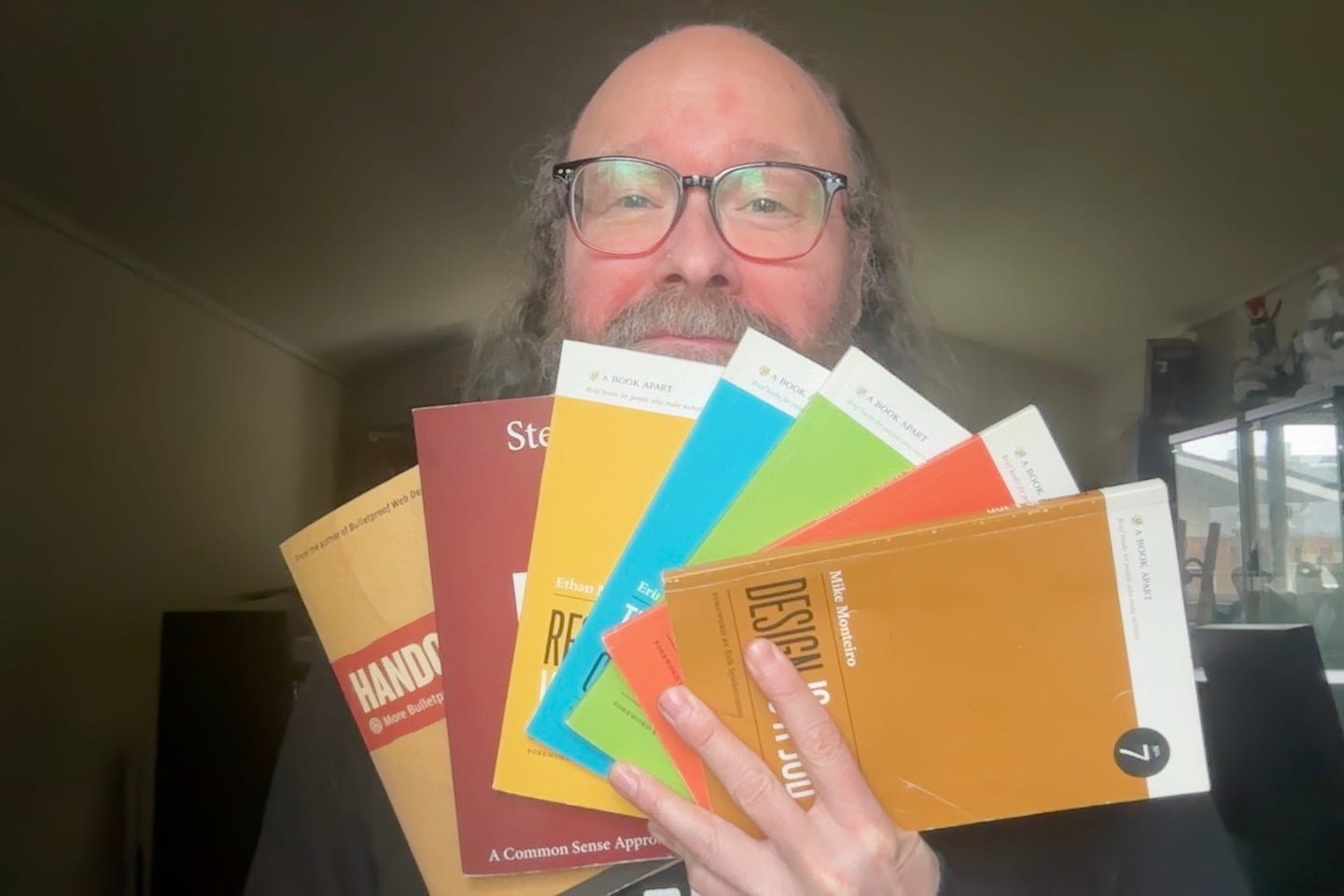
Lastly, a huge thanks from a self-taught designer/developer to some my fantastic teachers over the years who’ve contributed to the success of this self-taught designer, whether they knew it or not: Mike Montiero, Debbie Millman, Eric Meyer, Jeffery Zeldman, Ethan Marcotte, Dan Cedarholm, and Steve Krug